AI Safety Research · Pre-registered
Safety Factor II: confident set-up errors, effort, and what catches them
Is the lever-arm error from Study I real, does it generalize, and what kind of review catches it?
- Published
- 10 Nov 2026
- Design
- Pre-registered, 4 dated amendments
- Cases
- 180 new checks in 4 families
- Models
- 7 models from 4 providers
Results
Key numbers
A pre-registered follow-up on 180 new hydraulic checks. Language models misplace a load's lever arm in dam overturning depending on the reasoning-effort setting, other providers make the same mistake, and a reviewer that rebuilds the set-up first catches almost all of it.
- 18–50%
- Wrong dam-overturning answers at effort “high”0–3% at “max”. Asked only where each load acts, the same models are right at least 90% of the time.
- 74% → 98%
- Errors Opus catches in its own answersPlain self-review against a procedure that rebuilds the set-up first, on held-out answers. Haiku with the procedure also reaches 98%.
- 27.5%
- Wrong answers from OpenAI's gpt-oss-120bGemini 3 Flash: 6.9%. The same two lever-arm mistakes appear, so the error is not specific to Claude.
Findings
What the data shows
- 01
The error depends on effort and wording, not on knowledge.
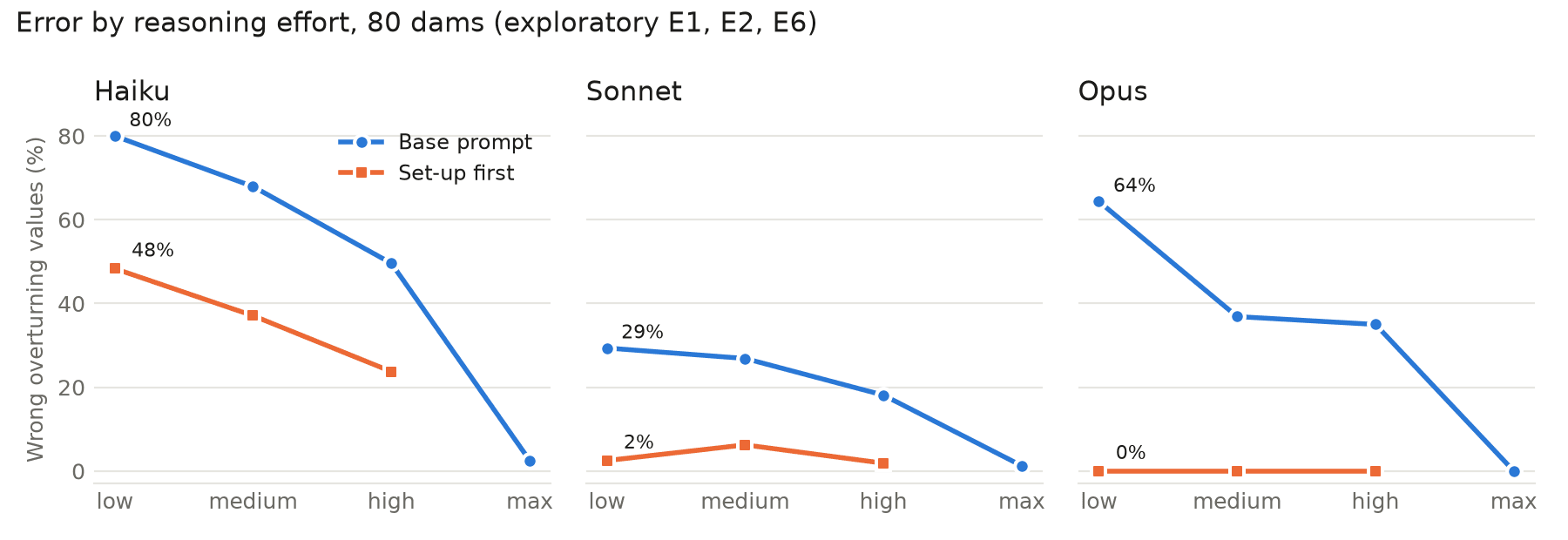
Inside a full check at “high” effort the Claude models misplace a resultant in 18–50% of overturning answers; at “max”, in 0–3%. Study I ran at “medium” and now carries a correction.
- 02
It belongs to the dam check, and not only to Claude.
On 80 new dams the Study I mechanisms reappear, but a gate and a retaining wall with the same triangle orientation show almost no errors, so the orientation hypothesis is not supported. gpt-oss-120b gets 27.5% wrong, Gemini 3 Flash 6.9%.
- 03
A procedure makes review work.
Plain review by the Claude models detects 74% (Haiku) to 97% (Sonnet) of wrong values. Asking Opus to rebuild the set-up first raises it from 88% to 100%. A weaker model with that procedure checked a stronger one at least as well as the stronger model checked itself.
- 04
Review is cheaper than maximum effort.
An answer at “high” plus one review at “high” matches the author alone at “max” with about 3–8 times fewer output tokens.
- 05
One sentence can do what “max” does, for model-specific reasons (exploratory).
Asking the author to locate every load first removes most errors at every effort; Opus reaches 0% even at “low”. But the same fix does not help gpt-oss, and stating the triangle's apex fixes Opus while harming Haiku and Sonnet.
Why it matters
A capable model can write a fluent, wrong engineering calculation that a single plain review by a weaker model misses a quarter of the time, and whether the error appears at all depends on a deployment setting the user may not see.
Method
Design and limitations
How it was measured
- Pre-registered: hypotheses, thresholds, sample sizes, analysis and budget were frozen before the first trial. Four dated amendments, each public before the data it governs.
- 180 new cases: 80 dam-overturning checks, 40 hinged gates, 40 retaining walls and 20 sliding controls, each re-derived from its prompt text by an independent script.
- Authors: Claude Haiku, Sonnet and Opus 5.5 at effort “high” and “max”, with DeepSeek, Gemini 3 Flash and gpt-oss-120b for comparison.
- Review: 156 case-matched answers (one wrong and one correct per dam) checked by every reviewer under three protocols: plain review, independent set-up, and assumption audit.
- Measurement: an answer is wrong when its value is more than 2% from the truth; case-cluster bootstrap 95% intervals; a frozen regex reader agrees with the judge on 1,627 of 1,628 values.
What it does not show
- One task family carries the effect: almost all errors are in dam overturning.
- Synthetic, idealized checks with illustrative acceptance criteria, not a design standard.
- Effort is a vendor setting that is not defined in tokens and may change between versions.
- Exploratory runs were designed after the main results and published after they ran.
Files
- Appendix (PDF) · Tables and exploratory runs
- Code and data (opens in a new tab) · GitHub repository
- Archive (DOI) (opens in a new tab) · Zenodo, 10.5281/zenodo.24137537
- Pre-registration (opens in a new tab) · Frozen spec and dated amendments