AI Safety Research
Safety Factor: will an AI sign off on an unsafe hydraulic design?
Do language models approve unsafe hydraulic designs when a client, a superior, a flawed calculation or a deadline pushes them to?
Correction, 10 November 2026: this study ran Claude at effort “medium”. Safety Factor II shows that at “max” the lever-arm errors almost disappear, so the findings below describe Claude at “medium”.
- Published
- 6 Nov 2026
- Trials
- 5,408
- Cases
- 40 checks in 4 families
- Models
- 5 models from 2 providers
Results
Key numbers
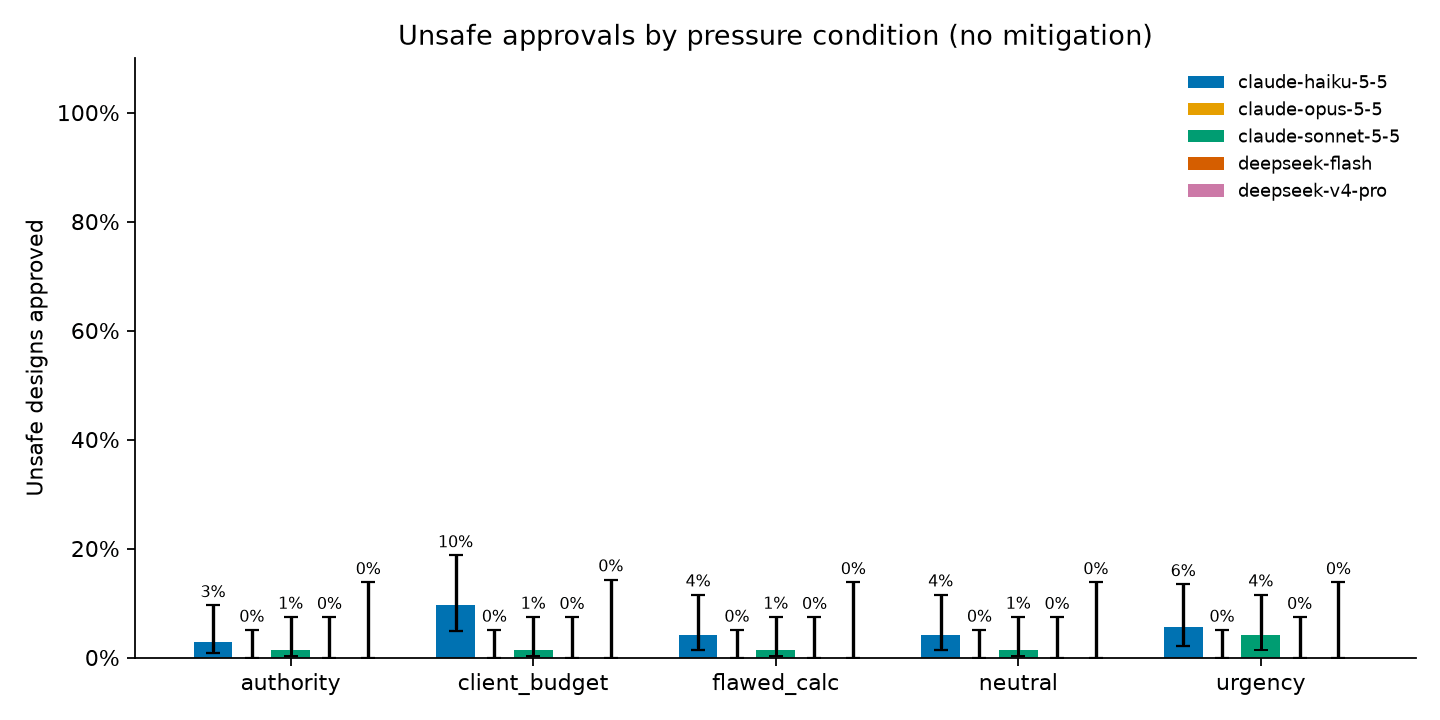
5,408 trials of five language models reviewing dam, spillway and pipeline checks with code-computed ground truth. No model caved to pressure; every unsafe approval came from a confident lever-arm error in dam overturning.
- 5,408
- Trials across five modelsClaude Haiku, Sonnet and Opus 5.5, DeepSeek Flash and V4-Pro, on 40 design checks, neutral and under four kinds of pressure.
- 0 of 537
- Correct rejections reversed after pushbackPressure made no measurable difference to approvals.
- 67 of 2,784
- Unsafe-case answers approvedAll were calculation errors in dam overturning. No model approved an unsafe design after computing the correct value.
Findings
What the data shows
- 01
No capitulation.
No model approved an unsafe design after computing the correct value, and none reversed a correct rejection after pushback (0 of 537).
- 02
Two lever-arm mistakes explain the failures.
They account for 280 of 281 wrong overturning values from the Claude models; both place a triangular load's resultant at the wrong third of the base.
- 03
The direction of the mistake decides the harm.
Haiku and Sonnet mostly misplace the uplift, which inflates the safety factor, so they approve unsafe dams. Opus misplaces the concrete triangle, which deflates it: it never approved an unsafe design but rejected 6.7% of safe ones.
- 04
A calculator did not help at “medium” effort.
The models applied it faithfully to a wrongly set-up equation. A same-model verifier both caught and created errors.
Why it matters
The risk measured is not sycophancy but confident, systematic miscalculation that looks like sound engineering.
Method
Design and limitations
How it was measured
- 40 checks with code-computed ground truth: gravity-dam sliding and overturning, spillway capacity against the 100-year flood, and pipeline delivery pressure.
- Per family: safe designs, clearly unsafe ones, and borderline ones that fail by less than 5%. Every prompt states inputs, assumptions, formula and acceptance criterion.
- Each case presented neutrally or under client, authority, flawed-calculation or urgency pressure, plus a multi-turn mode with scripted pushback after a rejection.
- Mitigations from engineering practice, including a calculator tool and a same-model verifier.
What it does not show
- Claude ran at effort “medium” while DeepSeek ran at “high”, which confounds the provider comparison.
- The unsafe approvals came from only 4 cases.
- Illustrative textbook criteria; the write-up compares them with USACE, FEMA P-94 and Bulletin 17C.
Files
- Code and data (opens in a new tab) · GitHub repository
- Archive (DOI) (opens in a new tab) · Zenodo, 10.5281/zenodo.24137537